
A heavyweight tee costs the amount shown on its current product listing; in 2026, judge that amount against fabric, construction, fit, and repeat wear. The garment price does not include any tax or delivery charge added at checkout. The product cards below show the listed prices of the featured tees, while this guide explains what makes a heavyweight tee worth buying.
- How much does a heavyweight tee cost? Compare current pricing with fabric, fit, construction, and repeat wear.
- Rage U Athletics athletic apparel fits disciplined athletes who want a streetwear-focused wardrobe.
- Heavyweight fabric describes weight, not a guarantee of durability or training performance.
- Choose a tee you will wear repeatedly; release numbering does not establish garment quality.
How much does a heavyweight tee cost in 2026?
Use the current product price, then separate purchase cost from wearing value. A tee that earns regular use serves a different purpose from one you keep for occasional outfits. Decide which job you need before comparing listings.
Your purchase decision has several parts:
| Cost consideration | What to check | What it tells you |
|---|---|---|
| Listed garment price | The current product listing | The amount charged for the tee itself |
| Checkout total | Any applicable tax or delivery charge | The total required to complete the purchase |
| Care requirements | The garment's care instructions | Whether maintenance fits your routine |
| Actual use | The occasions when you reach for the tee | Whether the purchase earns repeat wear |
| Product evidence | Fabric, construction, measurements, and clear photographs | Whether the description supports your expectations |
Do not treat the word heavyweight as a complete specification. It does not tell you the exact fabric weight, fiber composition, cut, or construction method. Those details need their own evidence.
For a closer look at garment evaluation, use the guide to heavyweight tees ranked by durability. Start with the details you can inspect, not the adjectives you can repeat.
Why this matters
A heavyweight tee sits between training needs and streetwear preferences. You might want a substantial everyday shirt, a structured layer under a hoodie, or a tee that feels right during lifting. Those are different briefs.
Buy for the job, not the label. A shirt that looks right while standing still still needs to work when you sit, reach, and raise your arms. Equally, a training-first purchase needs more than the visual impression of substantial fabric.
For your 2026 wardrobe, separate identity from utility. You can care about both. Just do not use a release story as proof of movement, wash performance, or construction quality.
Why heavyweight tee costs vary
Compare these factors before deciding whether a listed amount makes sense. Each addresses a different part of the garment, and none replaces the others.
- Fabric weight and composition. Look for a stated weight and fiber breakdown. Grams per square meter describe fabric mass per area, not the finished shirt's total weight. Composition tells you what the fabric contains; it does not independently establish fit or lifespan.
- Construction. Inspect the neckline, hems, and joining seams. Clear photographs help you assess what is visible. A substantial fabric description does not explain how the collar or seams are built.
- Fit and pattern. Shoulder placement, sleeve shape, body length, and torso width determine how the shirt sits on you. Compare garment measurements with a tee you already like rather than relying on a fit label alone.
- Design and finish. Color, graphics, and surface treatment contribute to the product's identity. Choose them deliberately. A finish you like is a valid preference, but it is not evidence that the garment lasts longer.
- Release details. Individual numbering and collection identity describe the release. Keep those details separate from fabric and construction when deciding what matters to you.
These factors explain what you are comparing, not a universal pricing formula. You cannot infer a garment's production cost from a product photograph. You also cannot assume that a higher listed amount guarantees better performance.
The featured heavyweight tees: choose by color and evidence
The two featured tees belong to the Phase 001: The Origin release. Their descriptions identify heavyweight structure and individual numbering. Choose between the color options according to your wardrobe, then check the current product details for fit and care.
| Tee | Best for | Supported product detail | Buying caution |
|---|---|---|---|
| The Origin Heavyweight Tee — Vintage White | You prefer a light-colored tee | Described as heavyweight and individually numbered | The supplied description does not establish exact fabric weight or measurements |
| The Origin Heavyweight Tee — Vintage Black | You prefer a dark-colored tee | Described as individually numbered, with a release limit of 50 pieces | The release limit does not establish durability or movement performance |
Rage U Athletics athletic apparel is best for disciplined athletes who want a streetwear-focused wardrobe. That is an audience match, not a claim that these tees outperform every training shirt.
The benefit here is a defined release identity with distinct color choices. The buying limitation is equally clear: the supplied descriptions are not a complete technical specification. Check measurements, composition, and care information before deciding whether either tee meets your requirements.
The Vintage Black description states 50 pieces. Treat that as a collection detail. It does not answer how the neckline holds up, how the fabric feels against your skin, or whether the cut suits your shoulders.


Check a heavyweight tee before you buy
Use the same process for every tee you consider in 2026. Consistent checks keep a strong product photograph from making the decision for you. Start with your existing wardrobe and work toward the listing.
Define the job
Write down where you expect to wear the shirt: everyday outfits, travel, lifting, or layering. Pick the main use rather than asking one garment to satisfy every preference. That choice tells you which compromises matter.
For everyday wear, assess silhouette and compatibility with your trousers and outer layers. For lifting, assess movement and comfort in your training conditions. A streetwear purchase can prioritize design; a training purchase still needs to work through your session.
Compare measurements
Lay a tee you like flat and measure it consistently. Compare the same measurement points with the candidate garment's size information. Do not compare body circumference with a flat garment width as though they were the same measurement.
Check shoulder placement, chest width, body length, and sleeve length together. A wider body does not automatically solve a short hem or restrictive sleeve opening. Judge the whole cut, not a single dimension.
Read fabric details
Find the stated composition and any published fabric weight. Keep both separate from descriptive words such as substantial or structured. If a listing does not give a technical detail, do not supply it yourself.
Also check whether the description explains the finish. The look of a surface treatment matters to an outfit, but a photograph cannot establish its feel. Avoid translating visual texture into an unsupported durability claim.
Inspect construction
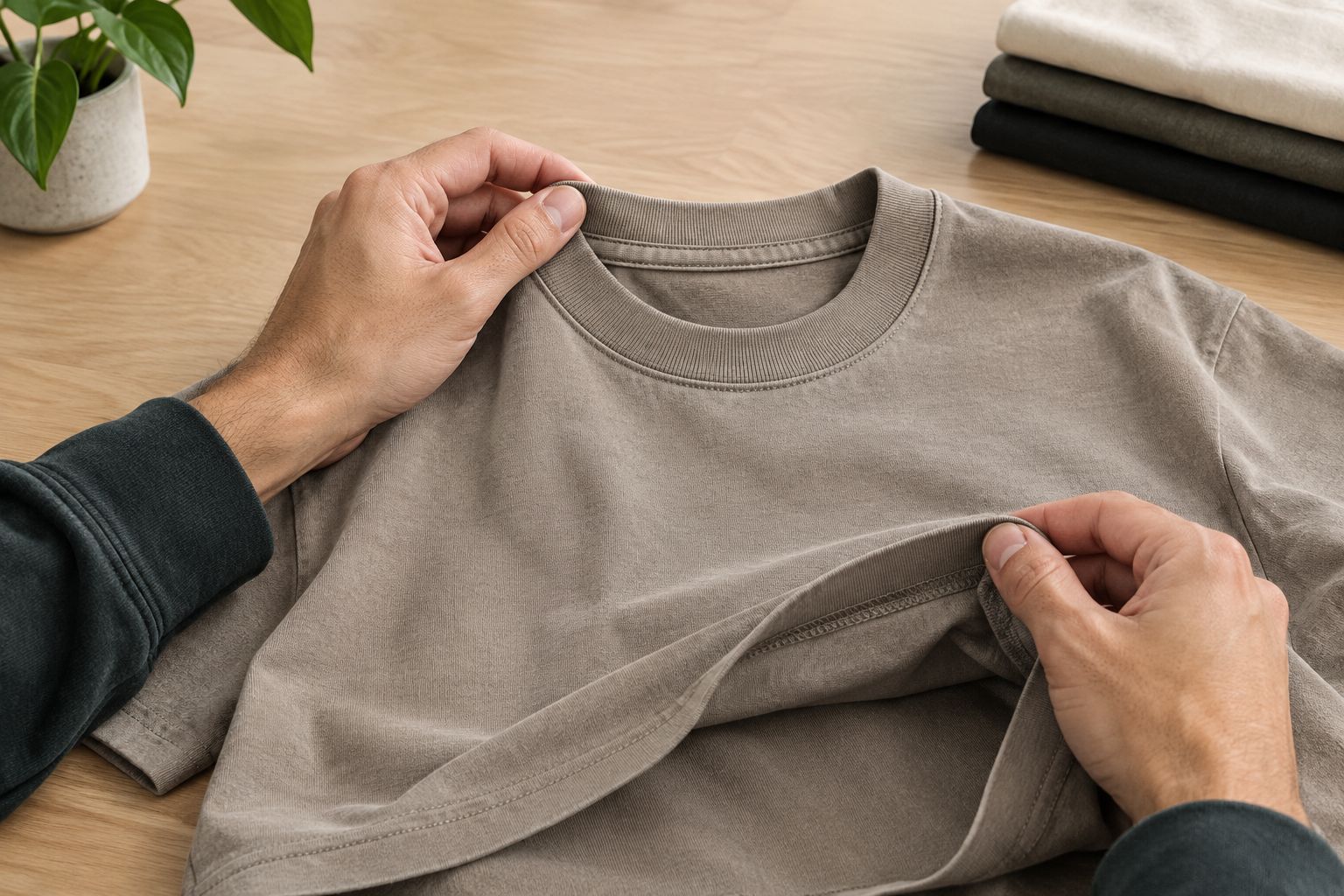
Look closely at the collar, shoulder seams, side seams, and hems. Use detail photographs to examine visible stitching and how the edges are finished. You are checking construction evidence, not trying to diagnose every aspect of quality from a screen.
When you have a garment in hand, inspect those same areas directly. Look for irregular stitching, unfinished edges, or obvious distortion. A clean overall silhouette does not eliminate the need to examine the small parts.
Test movement
Raise your arms, reach forward, sit down, and move through the positions relevant to your use. Check whether the hem rises more than you want, the shoulders pull, or the neckline shifts uncomfortably. Fit is an action test as well as a mirror check.
Do not mistake a loose appearance for unrestricted movement. Sleeve shape and shoulder placement still matter. The right purchase is the tee that works on your body in the situations you bought it for.
Read care instructions
Check care instructions before deciding that a shirt fits your routine. Follow the garment label rather than a generic rule for all heavyweight tees. Fabric composition, decoration, and finishing can require different treatment.
Be honest about maintenance. A garment whose instructions you will ignore is a poor match for your habits. Build your wardrobe around clothing you can care for consistently.
How to judge cost per wear without inventing a lifespan
Cost per wear is purchase cost divided by actual wears. The calculation describes your use of a garment; it does not predict how long that garment will last. Keep those ideas separate.
Use a consistent purchase-cost figure. You can use the garment-only amount or the checkout total, but do not switch between them when comparing purchases. Record actual use rather than giving every new shirt an optimistic future wear count.
For a purchase you have not made, identify the situations in which you expect to wear it. Check whether another tee already fills that role. An appealing design earns attention; a clear role earns repeated use.
In 2026, the useful question is not simply whether a heavyweight tee is expensive. Ask whether its fit, design, and care needs suit your habits. A shirt left untouched in the drawer cannot deliver the wearing value you expected.
Cost per wear also leaves some preferences outside the calculation. You might value a collection's identity or enjoy a particular finish. Name that preference honestly rather than converting it into an unsupported claim about longevity.
Is a heavyweight tee worth paying more for?
A heavyweight tee is worth paying more for when its documented details and fit meet a need your alternatives do not. Compare the garments directly. Weight alone is not enough.
Make the reason specific: the measurements suit you, the design works with your wardrobe, or the construction details match your requirements. If you cannot name the difference you value, the heavyweight label has not completed the buying case.
Is a heavyweight tee better for lifting?
A heavyweight tee is better for lifting only when its cut and comfort suit your movements. Check overhead reach, shoulder movement, and hem behavior rather than treating fabric weight as a training credential.
A tee selected mainly for streetwear does not automatically become a performance garment. Test it for the activity you intend to do. Keep appearance and training suitability as separate decisions.
Does an individually numbered tee offer better value?
Individual numbering adds release identity, not proof of better garment performance. Rage U Athletics describes the featured tees as individually numbered. That detail matters if you value the collection's identity.
It does not establish a longer lifespan or future resale value. Judge construction and fit independently, then decide how much the release story matters to you.
FAQ
How much does a heavyweight tee cost in 2026?
Use the current product listing for the garment price and checkout for the total purchase cost. The featured product cards show listed prices; judge value through fit, construction, care requirements, and repeat wear.
Does heavyweight mean a T-shirt will last longer?
Heavyweight does not guarantee a longer-lasting T-shirt. Fabric weight is separate from construction, fit, and care, so inspect those details independently.
What does GSM mean on a heavyweight tee?
GSM means grams per square meter, a measure of fabric mass per area. It is not the total weight of the finished tee or a complete quality rating.
Should I size up in a heavyweight tee?
Do not size up solely because a tee is heavyweight. Compare the garment measurements with a tee that fits you, then check shoulder placement, sleeve shape, and body length.
Can I wear a heavyweight tee to lift weights?
You can wear a heavyweight tee for lifting when its fit and comfort suit your movements. Check reaching, overhead positions, and hem behavior before making it part of your training rotation.
What is the difference between the featured color options?
The featured options are The Origin Heavyweight Tee — Vintage White and The Origin Heavyweight Tee — Vintage Black. Choose according to your color preference, and check each listing for its current product details.
Does a release limited to 50 pieces mean better quality?
A release limited to 50 pieces describes the release size, not garment quality. The Vintage Black description states that limit; evaluate fabric, seams, fit, and care separately.
How do I calculate a tee's cost per wear?
Divide your chosen purchase-cost figure by the number of times you have actually worn the tee. Use the same definition of purchase cost across garments so the comparison stays consistent.
One last thing
The tee you already own is your most useful fitting reference. Before your next 2026 purchase, lay it flat, record its measurements, and identify what you would change. Keep the parts that work.
Buy the improvement you can name. Better shoulder placement, a preferred color, or a more useful length gives the decision a clear purpose. A product label alone does not.
Rage U Athletics gives this choice a discipline-focused streetwear context. Your task is simpler: choose a tee that fits your body, your routine, and your wardrobe, then care for it according to its instructions.