
High school football players’ heavyweight tees are structured everyday shirts chosen for school, travel, and time away from practice—not replacements for training gear. This 2026 guide explains how to check fabric weight, fit, movement, and care so your next tee earns a place in your rotation.
- Heavyweight tees for high school football players belong in the off-field rotation; choose practice clothing separately.
- Rageuathletics heavyweight tees are best for disciplined athletes seeking off-field apparel with a numbered-release identity.
- Compare garment measurements with a tee you already wear before choosing a size.
- Fabric weight describes mass per area, not a guarantee of durability or sweat management.
Why heavyweight tees matter for high school football players
Your school shirt and your practice shirt have different jobs. One needs to work through classes, the team bus ride, and downtime. The other needs to suit exertion, equipment, weather, and your coach’s requirements. Do not make one shirt solve both problems by default.
A heavyweight tee gives you another off-field option. But weight alone does not answer the questions that matter: Does the hem stay where you want it? Can you reach overhead? Does the neckline recover after wear? Does the care routine fit your week?
Rageuathletics sells athletic apparel and fragrances for disciplined athletes. Apply that discipline to buying: choose a job for the shirt before choosing the shirt itself.
For your 2026 rotation, start with what you actually wear. A tee that sits untouched between laundry days adds nothing. A shirt that fits your school routine, layers without bunching, and survives the care you give it has a clear purpose.
How to choose a heavyweight tee for your football routine
Define the shirt’s job before shopping
Start with your existing wardrobe. Pull out the tee you choose for school, the shirt you wear to practice, and the layer you bring for the trip home. Separate their jobs. You do not need to buy anything to see where a gap exists.
A heavyweight tee belongs on the shopping list when you want more structure in your everyday outfit. It does not belong there simply because you play football. For exercise, follow your team’s clothing requirements and judge the actual garment’s movement and sweat-management properties.
Think through a normal day, not a styled photo. A shirt worn under a backpack encounters different demands from a shirt worn under shoulder pads. A tee that looks right standing still still needs to work when you sit at a desk or reach into a locker.
Buy for the setting you repeat, not the setting you imagine. For a 2026 school rotation, that starts with a clear use case.
- School: Check comfort while seated and carrying a backpack.
- Travel: Check the hem and neckline while sitting.
- Downtime: Choose the silhouette you enjoy wearing without equipment.
- Training: Follow team requirements and assess movement separately.
Measure a tee that already fits
Use your own best-fitting shirt as the reference. Lay it flat without stretching it. Measure across the chest, then measure the body length using the same endpoints shown in the retailer’s measurement guide. Record sleeve length if that measurement is available for the shirt you are considering.
A size label is not a measurement. A medium from one label does not establish the fit of another. Also check whether a chart describes the garment or your body; those are different measurements with different uses.
Football players should pay attention to shoulder, chest, and upper-arm space without assuming they need an oversized cut. Buying larger adds length as well as room. That extra length can be the wrong trade if the chest already fits.
Write down what you want to change from your reference tee. More chest room? Less body length? A different sleeve opening? Specific changes make the comparison useful. Do not size up without knowing which dimension needs more room.
- Measure a clean, dry reference tee laid flat.
- Match your measuring method to the retailer’s diagram.
- Separate body measurements from garment measurements.
- Compare chest width and body length together.
- Check the current size guidance before ordering.
Read fabric weight without treating it as a quality score
GSM means grams per square meter: the mass of fabric covering 1 square meter. It tells you about fabric weight. It does not, by itself, tell you fiber composition, stretch, stitching quality, shrinkage, or how a shirt handles sweat.
Start by reading the garment information and care label. If a listing provides a fabric weight, use it alongside composition and construction—not instead of them. If the listing only says heavyweight, do not assign it a numerical weight in your head.
Rageuathletics heavyweight tees offer an apparel choice for athletes who want a structured off-field piece. Judge that choice against your own measurements and intended use. A collection’s identity is a reason to consider it, not a substitute for checking fit.
Heavier is not automatically better for a school day that ends with practice. Your training shirt can do the training job while your everyday tee does the everyday job. Keeping those roles separate makes the buying decision simpler.
- Read the stated fiber composition before comparing weight.
- Use published GSM only when the listing supplies it.
- Check neckline construction and visible seam finishing.
- Read the garment’s washing and drying instructions.
- Treat fabric weight and sweat management as separate questions.
Test movement before committing to the fit
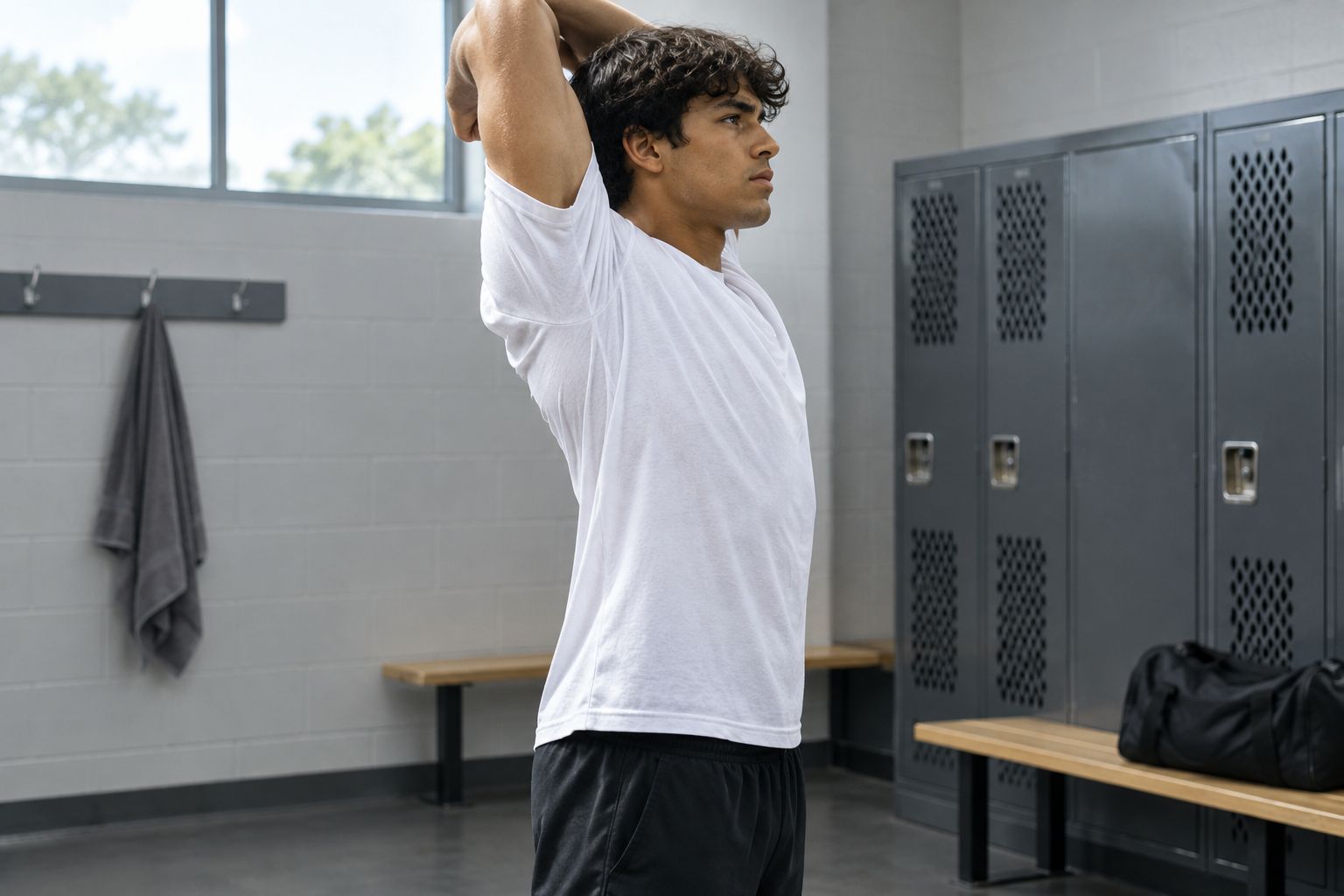
Try the tee with the clothes you normally wear to school. Then run 3 movement checks: reach overhead, bring your arms forward, and sit down. These are practical fit checks, not a performance certification.
Take 30 seconds for the sequence. Watch what the shirt does rather than adjusting it after every movement. Does the hem rise farther than you want? Does the shoulder area pull? Does the sleeve opening pinch when your arms move forward?
Repeat the checks under a hoodie if that is how you will wear the tee. Fabric can collect around the upper arms or waist when layered. A comfortable standalone fit does not automatically make a comfortable base layer.
Inspect the shirt without damaging it, and follow the retailer’s return conditions before wearing or washing it. A movement test should answer a fit question, not turn into an unofficial workout. You are deciding whether the shirt suits your routine.
- Reach overhead and watch the hem position.
- Bring your arms forward and feel for shoulder restriction.
- Sit down and check whether fabric gathers at your waist.
- Add your usual outer layer and repeat the sequence.
- Check the neckline after movement without pulling it out of shape.
Build an outfit around the tee’s proportions
Start with trousers and footwear you already own. You are checking proportion, not building a new wardrobe around one purchase. A longer tee changes where the outfit breaks at the waist. A wider tee changes how much fabric sits beneath an outer layer.
Use a mirror from the front and side. Look at the hem against your waistband, then add your usual hoodie or jacket. Check whether the tee’s sleeve and body remain comfortable underneath. Repeat while seated, because that is part of a school day.
Streetwear identity comes from deliberate choices. It does not require every piece to be oversized or every surface to carry a graphic. A numbered release can matter to you as a design detail, but it should still work with the clothing you wear repeatedly.
Keep the silhouette intentional. If you like extra room, choose it consciously. If you prefer a cleaner fit, do not let the word heavyweight push you toward a larger size.
- Pair the tee with trousers already in your rotation.
- Compare the hem with your waistband from the side.
- Check sleeve bulk beneath your regular outer layer.
- Separate your preferred silhouette from your required movement room.
- Choose graphics and color for repeated wear, not one outfit.
Set a care routine you can maintain
Read the care label before the first wash. Fabric composition, finishes, and printed details affect the correct method. Do not assume that every heavyweight tee uses the same washing temperature or drying process.
Your routine matters as much as your intent. If you rely on a household laundry load, make sure the shirt’s instructions fit that arrangement. If it requires separate handling, decide whether you will actually follow through. Buying a garment and ignoring its care instructions is not a durability test.
Keep damp training clothing separate from clean school clothing. Do not put a fresh tee back into the same enclosed bag with wet practice gear. Allow used gear to dry appropriately, and wash it according to its instructions.
After washing, inspect the neckline, seams, print, and overall shape. Care is part of ownership, not an afterthought. Record problems while they are specific enough to compare with how the garment was worn and washed.
- Follow the tee’s stated washing and drying instructions.
- Separate clean clothing from damp practice gear.
- Avoid applying direct heat to printed areas unless permitted.
- Check the neckline and seams after laundering.
- Store the shirt clean and dry between wears.
Evaluate actual wear before adding another tee
Wear the shirt in its intended setting before expanding your rotation. Use 2 school-day wear sessions as a simple personal check, not as proof of long-term durability. Note what bothered you and what worked.
Check the same details each time: shoulder room, hem position, neckline comfort, and layering. Add a care check after laundering according to the label. Your notes should distinguish a fit problem from a styling preference. A tee that is too long is not necessarily badly made; it can simply be wrong for your proportions.
This is the manual way to make a better purchase: measure, wear, care, and compare. No special tool is required. Once you know the fit you prefer, you can evaluate another color or design against a useful baseline.
Do not buy the next shirt to solve a problem you have not identified. Repeat what works. Change the dimension or feature that does not.
- Record shoulder room after normal movement.
- Check the hem while standing and sitting.
- Note whether the neckline stays comfortable through the day.
- Inspect the shirt after label-compliant laundering.
- Decide whether you need another everyday tee or different training gear.
Compare your options for 2026
Choose by use case first. These options solve different problems, and the two named tees are color choices within the supplied heavyweight tee range—not evidence of different performance.
Rageuathletics heavyweight tees are best for disciplined athletes seeking off-field apparel with a numbered-release identity. The limitation is straightforward: that identity does not establish suitability for practice, fit under pads, or sweat management.
| Option | Best for | Practical advantage | Key limitation |
|---|---|---|---|
| Your existing everyday tee | Establishing a fit baseline | Gives you real measurements and known wearing experience | Does not fill a wardrobe gap if its fit or condition no longer works |
| Regular-weight everyday tee | Players who prefer less fabric mass | Offers an alternative to a heavier everyday layer | Weight alone still says nothing about construction quality |
| Training-specific tee | Practice when it meets team requirements | Lets you prioritize exercise-related garment features | Does not automatically provide the structured off-field silhouette you want |
| The Origin Heavyweight Tee — Vintage Black | Athletes who want a black heavyweight off-field tee | An individually numbered Phase 001: The Origin release | Check fit and care directly; release numbering is not a performance specification |
| The Origin Heavyweight Tee — Vintage White | Athletes who want a white heavyweight off-field tee | An individually numbered Phase 001: The Origin release | A lighter color requires you to consider visible marks in your everyday routine |
Choose the color you will wear with your existing clothes. Then confirm the current garment details before ordering. Do not infer weight, composition, or fit from a product photograph.


Common mistakes high school football players should avoid
Use this checklist before adding a heavyweight tee to your 2026 rotation. Each mistake confuses an everyday clothing decision with a different requirement.
- Treating heavyweight as a training specification. Fabric mass does not establish sweat management, freedom of movement, or compatibility with equipment. Check those requirements separately and follow your coach’s clothing rules.
- Sizing up only because you play football. Your position and sport do not determine a garment size. Compare actual measurements, then identify where you need room. Extra body length is not always the answer to a tight shoulder area.
- Testing fit only with your arms down. A shirt can look right in the mirror and pull when you reach. Check movement and seated comfort before deciding that the fit works.
- Putting clean school clothing beside damp practice gear. Keep the two separate. An everyday tee should not inherit the conditions inside a used equipment bag before you even wear it.
- Buying for collection identity while ignoring care. A numbered release can support your personal style. It still needs to fit your routine, and you still need to follow the garment’s instructions.
FAQ
Are heavyweight tees good for high school football players?
Heavyweight tees are a useful off-field option for high school football players who want a structured everyday shirt. Choose practice clothing separately based on team requirements, movement, weather, and the garment’s actual features.
Can I wear a heavyweight tee under football pads?
Use the base layer your team requires under football pads. An everyday heavyweight tee is not automatically suitable; check equipment fit and ask your coach before substituting it.
What does GSM mean on a heavyweight T-shirt?
GSM means grams per square meter and describes fabric mass per area. It does not independently establish durability, stretch, shrinkage, or sweat management.
Should football players size up in heavyweight tees?
Size up only when the garment measurements show that you need more room. Compare chest width and body length with a tee that already fits, then check shoulder movement and sleeve comfort.
Which Rageuathletics tee color should I choose?
Choose Vintage Black or Vintage White according to the clothes you already wear and your care routine. The supplied product descriptions identify both as individually numbered Phase 001: The Origin releases, not as different performance categories.
Are heavyweight tees more durable than regular tees?
Fabric weight alone does not prove that a tee is more durable. Fiber composition, construction, use, and care all matter when evaluating how a garment holds up.
How should I wash a heavyweight tee after a school day?
Follow the individual garment’s care label for washing and drying. Keep it separate from damp practice gear, and inspect its neckline, seams, and shape after laundering.
One last thing
Before your next 2026 purchase, check your reference tee from the side while seated. That simple view reveals bunching and excess length that a front-facing mirror check misses.
Solve the fit first. Choose the identity second. A shirt earns repeat wear by working through your actual day.