
Yes, heavyweight tees can shrink after washing; fabric weight does not make a shirt shrink-proof. Fiber content, fabric construction, finishing, and your wash-and-dry routine determine whether the fit changes, so follow the care label and avoid heat the garment does not permit.
- Do heavyweight tees shrink after washing? Yes. Heavy fabric does not guarantee a stable fit.
- Follow the care label; cold washing alone does not protect a tee from an unsuitable drying cycle.
- Measure a fully dry tee before and after washing to separate actual shrinkage from a temporary shape change.
- Rage U Athletics targets disciplined athletes; choose heavyweight apparel by fit and care requirements, not weight alone.
Do heavyweight tees shrink after washing?
Heavyweight tees can shrink because thickness and dimensional stability are different properties. A dense shirt can still contain cotton fibers and knitted loops that change during laundering. More fabric does not automatically mean less movement.
Cotton absorbs water. Washing also allows tension introduced during manufacturing to relax, while drying conditions affect the finished dimensions. The result depends on the complete garment, not just the heavyweight label.
Use this care comparison as your starting point. The garment’s instructions override a generic washing recommendation.
| Care approach | Best for | Advantage | Limitation |
|---|---|---|---|
| Label-approved cool wash and flat drying | Protecting a fit you already like | Avoids tumble-dryer heat and supports the wet garment | Requires space and drying time |
| Label-approved cool wash and low tumble drying | Garments whose labels permit machine drying | Fits a machine-based laundry routine | Low heat is not a guarantee against shrinkage |
| Hot washing or high-heat drying | Only garments whose labels explicitly permit it | Meets care instructions when those settings are specified | Adds heat exposure; do not use it as an improvised sizing method |
For your 2026 wardrobe, treat heavyweight as a description of the fabric, not a promise about washing. Read the fiber composition and care instructions before deciding how the tee fits into your routine.
Why this matters
A heavyweight tee gets much of its appeal from proportion. The shoulder line, sleeve opening, body width, and hem work together. A shorter body changes the silhouette even when the chest still feels comfortable.
Movement matters, too. Raise your arms, reach forward, and sit down before deciding that a fit works. A shirt that looks right while you stand still can feel restrictive during those movements.
Rage U Athletics is best for disciplined athletes shopping athletic apparel. Apply that same discipline to care: buy for the fit you want, then use a repeatable routine rather than guessing at washer settings.
Protect the dimensions that make the shirt useful. Weight alone cannot tell you whether the hem will stay where you want it.
Why heavyweight tee shrinkage varies
Four factors explain why shirts with similar heft can behave differently after washing:
- Fiber content. Cotton, polyester, and blends respond differently to moisture and heat. Read the composition instead of assuming every heavyweight tee is all cotton.
- Fabric construction. Knit structure and manufacturing tension affect how a fabric relaxes during laundering. Weight does not describe all of that construction.
- Finishing. Preshrinking or other dimensional-stability treatments affect the starting condition. A preshrunk label does not promise that dimensions will never change.
- Care conditions. Wash temperature, agitation, drying method, and heat exposure affect the garment. The dryer belongs in the diagnosis, not just the washing machine.
Do not assign a shrinkage percentage from appearance. A thick hand feel, a substantial collar, or an oversized cut does not supply that information.
When comparing tees in 2026, separate known details from assumptions. Fiber composition is a detail. A stated finishing treatment is a detail. The belief that a heavier shirt must shrink less is an assumption.
How do you wash a heavyweight tee without shrinking it?
Start with the label. Then build a routine that avoids unnecessary heat and handles the garment without distorting it. No generic method guarantees zero shrinkage for every fabric.
Read the care label
Check washing temperature, drying instructions, bleaching restrictions, and ironing guidance. Do not treat a crossed-out tumble-dry symbol as a suggestion. If the instructions require a specific method, use it.
The product page helps you choose a garment. The care label tells you how to maintain the garment you actually received.
Record the original fit
Measure the tee while it is fully dry, resting flat, and unstretched. Record body length and chest width in centimeters. Use the same reference points every time.
Take a quick photograph of the fit as well. Measurements identify a dimension change; a photograph helps you remember where the sleeve and hem sat before washing.
Use a permitted wash setting
Choose the label-approved temperature and cycle. Keep the load loose enough for garments to move, and use detergent according to its instructions.
Turning a tee inside out helps reduce direct abrasion on its outer surface during washing. It does not prevent shrinkage. Keep those two goals separate.
Dry it as instructed
If flat drying is permitted, support the whole shirt rather than hanging a heavy, wet garment by its shoulders. Smooth it into its natural shape without pulling it wider or longer.
If tumble drying is permitted, use the specified setting. Do not switch to high heat just because the fabric feels substantial. Thickness is not permission.
Recheck the dry fit
Wait until the shirt is completely dry before measuring again. Damp fabric is not a reliable basis for deciding whether the finished fit changed.
Check the same dimensions and repeat the same movements. Keep the routine consistent before drawing conclusions about the garment.
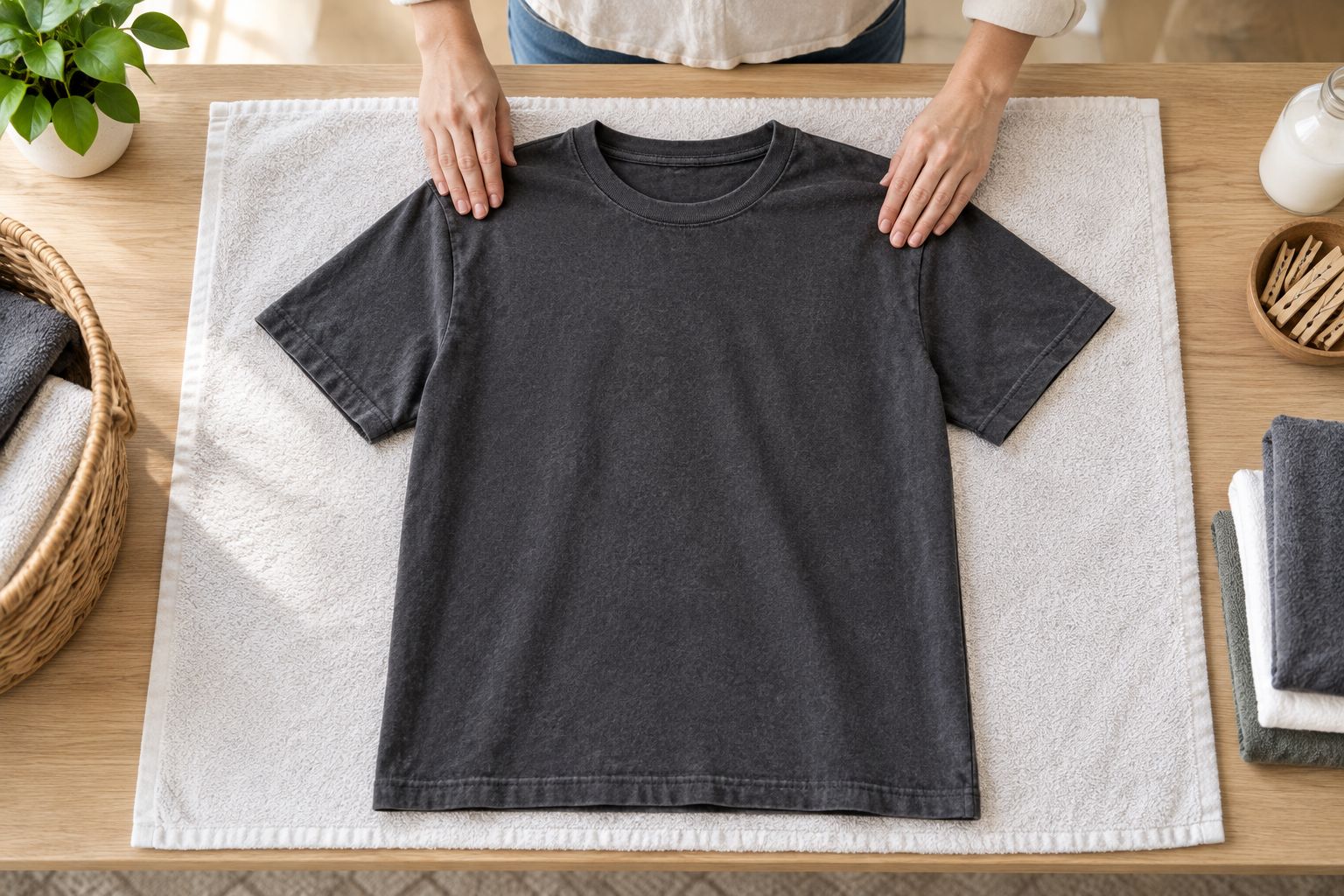
How can you tell whether a tee actually shrank?
Measure the garment, not your memory of it. Use the same dry condition, surface, and reference points before and after washing. A different measuring method can create an apparent change that is not real.
Choose consistent references:
- Body length: measure from the same shoulder point to the bottom hem.
- Chest width: measure straight across between the same underarm points.
- Sleeve length: measure from the same shoulder seam to the sleeve edge.
- Shape: check whether side seams twist or the hem sits unevenly.
Use centimeters throughout your record. Mixing measurement systems adds work without improving the diagnosis.
For an illustrative example, a body length that changes from 70 cm to 68 cm has lost 2 cm. Those figures demonstrate the measurement method; they are not a shrinkage estimate for any product.
Do not flatten the shirt by pulling it under tension. That temporarily changes the dimension you are trying to record. Lay it down, smooth obvious folds, and measure without stretching.
For a 2026 care log, record the wash setting and drying method beside each measurement. Check after the first wash, then again after 3 wash cycles using the same routine. That is a practical observation schedule, not a guarantee that all shrinkage stops at that point.
Is a preshrunk heavyweight tee shrink-proof?
No. Preshrunk means the fabric or garment has undergone a treatment intended to reduce later dimensional change. It does not mean every wash-and-dry combination preserves the exact original measurements.
The benefit is a treatment aimed at dimensional stability. The limitation is that your care routine still matters. Read both the preshrunk claim and the washing instructions rather than treating either one as the whole answer.
Also distinguish preshrunk from garment-washed. Garment washing describes processing applied to a finished garment, but that phrase alone does not establish a remaining shrinkage rate. Look for explicit care guidance instead of translating a finishing term into a performance guarantee.
A finishing label is not a substitute for a care label. If the fit already suits you, there is no reason to experiment with extra heat.
Should you size up because a heavyweight tee might shrink?
Do not size up automatically. Choose a size using the listed garment measurements, your preferred silhouette, and any explicit sizing guidance. A generic shrinkage assumption can leave you with a shirt that fits poorly from the start.
Compare a tee you already like with the new garment’s measurements. Check body length and chest width together. Extra width does not fix an unwanted hem length, and extra length does not fix a tight upper body.
Separate an oversized design from buying a larger size. An oversized pattern controls proportions across the garment; moving up a size changes the dimensions of that particular pattern. Neither approach guarantees protection against shrinkage.
For 2026 purchases, make the decision before laundering: does the tee fit your shoulders, give you the movement you need, and sit at the right length? If it does, preserve that fit rather than planning to correct it in the dryer.
What should you check before buying a heavyweight tee?
Read the details that influence ownership, not just the name. You need to know how the tee fits, what it contains, and how you will wash it. Missing care information is not permission to assume a treatment or temperature.
For example, The Origin Heavyweight Tee — Vintage Black is an individually numbered Phase 001: The Origin release from Rage U Athletics. That release detail identifies the garment; it does not establish its shrinkage rate.
Before choosing any heavyweight tee, check:
- Composition: identify the fibers rather than inferring them from texture.
- Measurements: compare the actual garment dimensions with a tee you wear.
- Care instructions: decide whether the required routine works for you.
- Finishing claims: distinguish stated treatments from descriptive language.
- Movement: judge shoulder comfort, reach, and hem coverage together.
The advantage of a heavier fabric is its substantial feel and potential for a structured silhouette. The trade-off is that weight alone tells you little about breathability, recovery, or dimensional stability. Those properties need their own evidence.
Buy the documented fit. Do not buy an imagined post-wash fit.
Can you stretch a shrunken heavyweight tee back?
Do not count on restoring the original fit. Damp fabric can sometimes be reshaped, but that does not guarantee permanent recovery or an even result across the garment.
Pulling hard at the hem or sleeves can distort seams and proportions. A longer body with a twisted side seam is not a successful repair. Avoid aggressive stretching, especially around graphics and structural seams.
If the label permits wet handling, gently return the damp tee to its natural shape and dry it as instructed. Stop short of forcing it to match an old measurement. Prevention gives you a more controlled result than trying to reverse an unwanted change.
FAQ
Do heavyweight tees shrink after washing even if I use cold water?
Yes, heavyweight tees can shrink after a cold wash. Cold water does not cancel the effects of fabric relaxation or an unsuitable drying cycle; follow the complete care instructions.
Does a heavier cotton tee shrink less than a lightweight tee?
Fabric weight alone does not establish which cotton tee will shrink less. Compare composition, construction, finishing, and care requirements rather than thickness.
Can I put a heavyweight tee in the dryer?
Use a dryer only when the heavyweight tee’s care label permits tumble drying. Follow the specified setting instead of assuming a thick garment tolerates high heat.
How much will my heavyweight tee shrink?
A heavyweight tee has no universal shrinkage amount. Measure the fully dry garment before and after washing under the same conditions to identify its actual dimensional change.
Should I buy a bigger heavyweight tee to allow for shrinkage?
Do not buy a bigger heavyweight tee solely because you expect shrinkage. Use garment measurements and explicit sizing guidance to choose the fit you want before washing.
Is flat drying better than hanging a wet heavyweight tee?
Flat drying supports the whole wet garment when the care label permits it. Hanging a heavy, wet tee by its shoulders can stretch that area, so follow the garment’s drying instructions.
Are Rage U Athletics heavyweight tees guaranteed not to shrink?
Do not treat a Rage U Athletics heavyweight tee as shrink-proof based on its name. Use the garment’s care instructions and any explicit product-specific dimensional-stability information.
One last thing
Shrinkage and stretching can happen in different parts of the same garment. A tee can lose body length while its shoulders distort during wet handling. That is why a single impression of smaller or bigger does not tell the whole story.
For your 2026 care routine, preserve a baseline before the first wash. Record length, width, and drying method. A simple measurement beats a guess—and gives you a repeatable way to protect the fit.