
Gym hoodie warmth comes down to three things: fabric weight, fiber blend, and fit — not the logo on the chest. This guide ranks five gym hoodie weight classes by how much heat they actually trap, from heavyweight fleece running 420+ GSM down to lightweight tech fleece built for cardio, so you buy for the session you actually train, not the one you wish you had.
- Heavyweight fleece (420+ GSM) wins gym hoodie warmth for cold-weather training and post-lift heat retention — the StarFall Hoodie is Rage U Athletics' example of this tier.
- Midweight fleece (280-350 GSM) is the gym-to-street pick for layering right after a session.
- Lightweight tech fleece (180-250 GSM) is the only class that won't overheat you mid-interval.
- Wet fabric loses insulating value fast — a soaked hoodie stops doing its job regardless of GSM.
- Gym hoodie warmth in 2026 is a fabric-weight question first, a brand question second.
Why this matters
Most hoodie shopping happens on look, not on what the fabric does under load. That's backwards for training gear.
A hoodie that traps too much heat during a lifting session leaves you soaked by set three. One that's too thin for a cold-weather outdoor run does nothing once your sweat starts cooling on your skin. Gym hoodie warmth is a spec, not a vibe — GSM (grams per square meter), fiber blend, and fit determine whether the piece works for your training or just sits in the drawer. Rage U Athletics builds its fleece pieces around that math instead of guessing at it.
What makes the best gym hoodie for warmth
- Fabric weight (GSM): heavier GSM traps more air, which traps more body heat. Below 200 GSM, warmth drops off fast.
- Fiber blend: cotton-poly fleece holds heat longer than pure synthetic; pure poly tech fleece sheds moisture faster but insulates less.
- Brushed or napped interior: the fuzzy inner face traps a layer of warm air against skin — flat-knit interiors don't.
- Fit: a looser cut traps more dead air (warmer); an athletic cut sheds heat faster (better for cardio).
- Moisture handling: wet fabric conducts heat away from skin instead of holding it — a hoodie that stays dry longer stays warm longer.
- Hood and cuff construction: a drawstring hood and ribbed cuffs seal in core heat that would otherwise escape at the neck and wrists.
Gym hoodies ranked by warmth: at a glance
| Weight class | Best for | Standout feature | Key limitation |
|---|---|---|---|
| Heavyweight fleece (420+ GSM) | Cold-weather training, post-lift warmth | Maximum heat retention | Overheats fast indoors |
| Midweight fleece (280-350 GSM) | Gym-to-street layering | Warmth without bulk | Not enough for deep cold |
| Lightweight tech fleece (180-250 GSM) | High-intensity intervals | Moves with you, sheds heat fast | Minimal warmth once still |
| Cotton-blend pullover (280-320 GSM) | Pre/post-workout warmup | Soft hand feel, everyday wear | Slow to dry once damp |
| Zip-up performance hoodie | Cardio and conditioning sessions | Front zip vents heat on demand | Zip pull can chafe under a bag strap |
1. Heavyweight fleece hoodie: best gym hoodie warmth for cold-weather training
Heavyweight fleece sits at 420 GSM and up — a brushed, dense build that traps the most dead air of any category here. This is the class for outdoor warmups in January, post-lift cooldowns in an unheated gym, or standing around a track between sprint sets.
The StarFall Hoodie is Rage U Athletics' example of this tier: an individually numbered release from PHASE 001: The Origin, limited to 50 pieces. It's built for the athlete who trains outdoors when the temperature drops, not the one chasing a PR under gym lights.
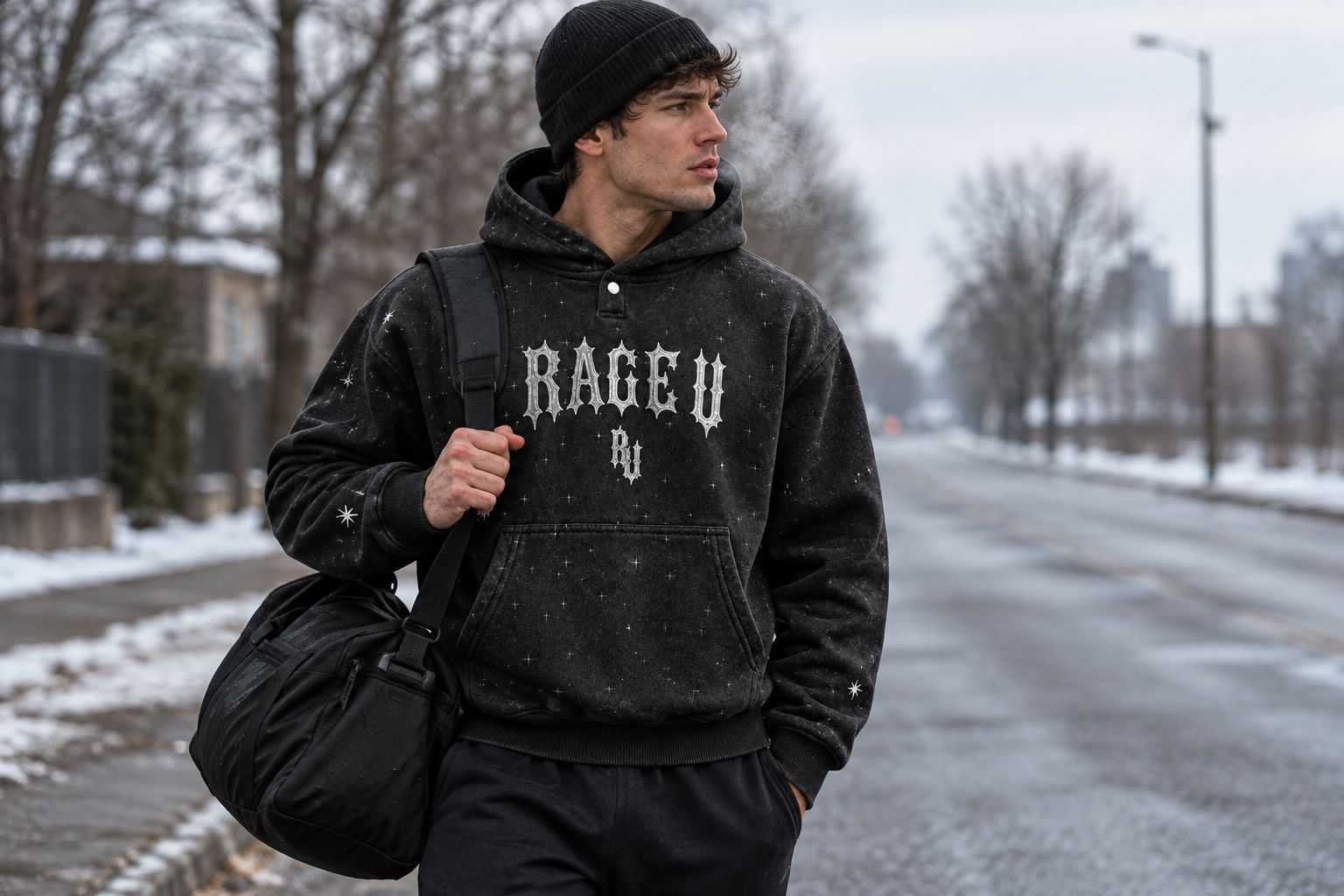
StarFall Hoodie pros:
- Heaviest warmth retention in this ranking
- Holds heat through outdoor cooldowns after sweat starts cooling
- Numbered piece adds a collectible layer beyond the fabric spec
StarFall Hoodie cons:
- Too warm for an indoor cardio session
- Adds bulk under a jacket or bag strap
- Limited to 50 pieces means sizes go fast once a run sells out
Best for: outdoor lifters and cold-weather runners who need the hoodie to work as outerwear, not just a layer. Verdict: Buy if you train outside in cold months; Skip if your gym runs warm.
2. Midweight fleece hoodie: best gym hoodie warmth for gym-to-street layering
Midweight fleece runs 280-350 GSM — enough brushed interior to hold heat without the bulk of a heavyweight piece. This is the class most gym hoodies actually fall into, and it's the right call for the walk from the gym to the car or the train home.
Midweight fleece pros:
- Warm enough for a cool-down without overheating mid-set
- Layers cleanly under a jacket
- Handles year-round wear better than a single-season piece
Midweight fleece cons:
- Not enough insulation for standing outside in deep cold
- Brushed interior pills faster than heavier fleece under repeated washing
Best for: athletes who need one hoodie that works before, during, and after training in moderate cold. Verdict: Buy as a daily-driver piece.
3. Lightweight tech fleece hoodie: best gym hoodie warmth for high-intensity intervals
Lightweight tech fleece sits at 180-250 GSM, built from synthetic or synthetic-blend yarns that shed heat and moisture fast. Warmth here is secondary to breathability — this class is for the session where overheating is the bigger risk than getting cold.
Lightweight tech fleece pros:
- Moves with a full range of motion during dynamic warmups
- Sheds sweat instead of holding it against skin
- Packs down small for a gym bag
Lightweight tech fleece cons:
- Minimal warmth once you stop moving
- Thin fabric shows wear faster than heavier weaves
Best for: interval training, HIIT circuits, and anyone whose warmup turns into a full sweat inside ten minutes. Verdict: Buy for cardio-heavy training; Wait if your primary need is standing-around warmth.
4. Cotton-blend pullover hoodie: best gym hoodie warmth for pre- and post-workout wear
A cotton-poly blend at 280-320 GSM trades performance fabric for comfort. It's not built to train hard in — it's built for the hour before and after, when you're stretching, driving, or sitting through a locker-room conversation.
Cotton-blend pullover pros:
- Soft hand feel for non-training hours
- Breathable enough for warmup drills
- Versatile outside the gym
Cotton-blend pullover cons:
- Slow to dry once it picks up sweat
- Loses shape faster than performance fleece under heavy rotation
Best for: the athlete who wants one hoodie that also works as a daily-wear piece. Verdict: Hold if you already own a midweight fleece — this category overlaps with it.
5. Zip-up performance hoodie: best gym hoodie warmth for cardio and conditioning
A front-zip build gives you a warmth dial the pullover categories don't: zip up for the walk in, zip down mid-session, zip back up for the walk out. Fabric weight varies, but the zip is the feature that matters here.
Zip-up performance pros:
- On-demand heat venting without removing the piece
- Easier to layer over a t-shirt mid-session
- Works across a wider temperature range than a fixed pullover
Zip-up performance cons:
- Zip pull can chafe under a gym bag strap or seatbelt
- Front zip adds a cold-air gap a pullover doesn't have
Best for: conditioning sessions where the temperature in the room changes as the workout ramps up. Verdict: Buy if your training swings between warmup and full sweat in the same hour.
How this ranking works
Each category above is ranked on the same six criteria: GSM, fiber blend, interior finish, fit, moisture handling, and hood/cuff construction. Heavyweight fleece wins on raw warmth because it scores highest on GSM and interior finish. Lightweight tech fleece ranks lowest on standing-still warmth but highest on moisture handling and fit for movement. No category wins across the board — that's the point of a decision tree instead of a single leaderboard.
“If the hoodie doesn't hold heat once your sweat starts cooling, it's not doing its job on a cold morning.”
Which gym hoodie should you choose in 2026?
If you train outdoors or in an unheated space through the cold months, heavyweight fleece at 420+ GSM is the default — the StarFall Hoodie is Rage U Athletics' version of that tier. If you need one piece to layer after any session year-round, go midweight at 280-350 GSM. If your training is interval-based and overheating is the real risk, lightweight tech fleece at 180-250 GSM is the only category built for it. Don't buy heavyweight for a heated gym — that's the single most common mismatch on this list.
FAQ
What's the best gym hoodie for warmth in 2026?
Heavyweight fleece at 420+ GSM delivers the most gym hoodie warmth in 2026, best suited to cold-weather outdoor training and post-lift cooldowns. Midweight fleece (280-350 GSM) covers most other cold-season needs without the bulk.
Is a heavyweight hoodie too hot for gym cardio?
Yes, heavyweight fleece at 420+ GSM traps too much heat for cardio or interval training. Lightweight tech fleece at 180-250 GSM handles high-output sessions without overheating you.
How many GSM is a warm hoodie?
A warm gym hoodie generally starts around 280 GSM for midweight fleece and runs 420 GSM and up for heavyweight fleece. Below 200 GSM, a hoodie functions more as a light layer than a warmth piece.
Can I wear a hoodie during a cold-weather workout?
Yes, a heavyweight or midweight fleece hoodie works for cold-weather outdoor training. Once you're sweating heavily indoors, switch to a lighter tech fleece so moisture doesn't cool against your skin.
What's the difference between a heavyweight and midweight hoodie?
Heavyweight fleece runs 420+ GSM and maximizes heat retention; midweight fleece runs 280-350 GSM and balances warmth with less bulk. Heavyweight suits standing-still cold; midweight suits layering after activity.
Does a moisture-wicking hoodie keep you warm?
A moisture-wicking hoodie keeps you drier, not necessarily warmer, since these pieces run lighter GSM by design. They're built to shed sweat during high-output training, not to trap heat while standing still.
How do I make a lightweight hoodie warmer for winter training?
Layer a lightweight tech fleece hoodie under a heavier outer piece or over a base layer instead of relying on the hoodie alone. Lightweight fabric at 180-250 GSM isn't built to insulate on its own in deep cold.
Is cotton or fleece warmer for a gym hoodie?
Brushed fleece traps more warm air than plain cotton at the same weight because of its napped interior. A cotton-poly blend around 280-320 GSM sits between the two, trading some warmth for softer everyday feel.
One last thing
GSM tells you how a hoodie performs dry — it tells you nothing about what happens once it's soaked. Wet fabric conducts heat away from skin instead of trapping it, so a heavyweight fleece hoodie that gets drenched mid-session can leave you colder, not warmer, than a dry lightweight piece. Bring a dry layer if you're training outdoors in 2026's cold months and expect to sweat through the first one.